Do you have a Safe Routes to School Coordinator in your area?
If you do, maybe it would be a good idea to connect with that person. Safe Routes to School (SRTS) is a federally run program that operates in every state and many communities to promote safe walking and biking routes to schools. The program recently received a national Harvard Bright Ideas in Government award, which recognizes and promotes creative government partnerships. The national director of the SRTS program attributes the award to the willingness of local and state organizers to make data-driven program decisions. "The policy experts selecting SRTS as a Bright Ideas award recipient pointed to the program's ability to obtain information on school travel habits from so many schools and communities, as well as how accurate the data is in forming and understanding national trends." Some of the other winners include local government networks that promote sustainability, video interviewing of human services clients, due to transportation challenges, and many education and employment-related projects, among others. (Sources: AASHTO Journal, Harvard Kennedy School of Government's Ash Center)
[Streetcar in Castro neighborhood of San Francisco.]
Technical Assistance Opportunities
Smart Growth America is offering free technical assistance in the form of one-or-two-day workshops for communities on such topics as transportation performance measurement and planning for small communities. The application deadline is next week on Oct. 25.
The National Endowment for the Arts (NEA) is gearing up for a round of Our Town grants. These grants are $25,000 to $200,000 each, for creative placemaking projects that contribute towards the livability of communities and help transform them into lively, beautiful and sustainable places with the arts at their core. Our Town will invest in creative and innovative projects in which communities, together with their arts and design organizations and artists, seek to: Improve their quality of life; encourage greater creative activity; foster stronger community identity and a sense of place; and revitalize economic development. I am thinking public art at bus stops, transit and intercity stations. The application deadline is Jan. 14, 2013.
Webinars: Fare Free and Advisory Committees
As one of my panel members at a fare-free session a few years ago said, if the transit is good, fare free will make a big difference in ridership; but people will not use a lousy service even if it is free. That said, if you are intrigued (as I am) by the possibilities of fare-free service, next month the National Transit Institute is hosting a webinar, Implications and Outcomes of Fare-Free Transit Systems (TCRP Synthesis 101), on Nov. 15, 2012.
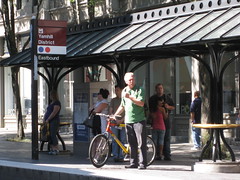
[Bike parking opportunity in Baltimore, near the Convention Center and Camden Yards ballpark.]
A secret to effective partnerships and decision making groups is to have the right people involved, people who have authority, energy or magical charms to make things happen. An Easter Seals Project Action webinar, BORPSAT: Bunch of the Right People Sitting Around the Table --Lessons for Maximizing the Effectiveness of your Transportation Advisory Committee, will address this issue on October 24. The webinar will discuss ways to ensure that diverse stakeholders, including representatives of the disability community, are involved as well as strategies for effective structure and operation of committees To register, email your name, ZIP code, phone number, email address, organization, and job title to registration@easterseals.com with the subject line "BORPSAT." (Caveat: There might not be a discussion of magical charms.)
Showing posts with label Easter Seals Project ACTION. Show all posts
Thursday, October 18, 2012
Thursday, February 16, 2012
Project ACTION Offers Practical Answers for People with Disabilities
Easter Seals Project ACTION
The new Accessible Transportation for Students—New Online Community will help students, their families, educators, human service providers, and transit professionals to learn from each other. Participants can use this forum to share stories and strategies related to providing accessible and inclusive transportation for students who are in school as well as those transitioning to post-school settings. Participants may discuss how transportation education content is integrated into class curriculum, instruction and academic standards; and upload or post links to helpful resources, projects or organizations.
ESPA's newsletter has a new feature, Ask Project ACTION, which poses a practical query from a person with a mobility disability. This month's question and answer are about who is responsible for snow removal at bus stops. For the person writing in, this is an important issue because he or she is afraid that ice and snow at the stop will interfere with walking with a cane (though rubber tips have no traction on ice) and cause a fall.
Local Stories - Coordination
In Campbell County , WY., coordination is moving forward. The Basin Radio Network reports that a team of organizations are working together on a coordination plan, one of the first steps of which is to educate and seek support from local political leaders. The article, Group works to coordinate public transportation, lists the organizations involved and goes into detail about the near-term plan. Staff from the team of organizations attended the recent Colorado/Wyoming Institute for Coordination held in November 2011.
Like many communities, Yuma County, AZ., is experiencing reductions in transit service. For people with disabilities, these cuts are significant because there are limited or no transportation alternatives available. Dial-A-Ride alternative arranged, an article on the YumaSun website, tells the story of a woman who retired early due to a disability and what dial-a-ride cutbacks, ADA transportation rules, and non-profit efforts have meant for her.
NYC Engages Riders - And They Have Opinions
Miracles do happen and one is going on in my hometown of New York (that's the city). The New York Times reports that subway announcements may be suggested by the public. The comments, with suggested announcements, are the best part. Warning: Some of the comments to the New York Times article have a biting, NYC humor. Other comments suggesting announcements are charming, such as requests for facts about construction of famous buildings, sports scores, and fanciful destinations (platform 9 3/4 was one; anyone heading to Hogwarts?). My favorite announcements when I lived in New York were on the D train, when it was still the Brighton Line. When the train left the city, a conductor every evening would declare that we were entering the bee-bopping borough of Brooklyn. How right he was.
The new Accessible Transportation for Students—New Online Community will help students, their families, educators, human service providers, and transit professionals to learn from each other. Participants can use this forum to share stories and strategies related to providing accessible and inclusive transportation for students who are in school as well as those transitioning to post-school settings. Participants may discuss how transportation education content is integrated into class curriculum, instruction and academic standards; and upload or post links to helpful resources, projects or organizations.
ESPA's newsletter has a new feature, Ask Project ACTION, which poses a practical query from a person with a mobility disability. This month's question and answer are about who is responsible for snow removal at bus stops. For the person writing in, this is an important issue because he or she is afraid that ice and snow at the stop will interfere with walking with a cane (though rubber tips have no traction on ice) and cause a fall.
Local Stories - Coordination
In Campbell County , WY., coordination is moving forward. The Basin Radio Network reports that a team of organizations are working together on a coordination plan, one of the first steps of which is to educate and seek support from local political leaders. The article, Group works to coordinate public transportation, lists the organizations involved and goes into detail about the near-term plan. Staff from the team of organizations attended the recent Colorado/Wyoming Institute for Coordination held in November 2011.
Like many communities, Yuma County, AZ., is experiencing reductions in transit service. For people with disabilities, these cuts are significant because there are limited or no transportation alternatives available. Dial-A-Ride alternative arranged, an article on the YumaSun website, tells the story of a woman who retired early due to a disability and what dial-a-ride cutbacks, ADA transportation rules, and non-profit efforts have meant for her.
NYC Engages Riders - And They Have Opinions
Miracles do happen and one is going on in my hometown of New York (that's the city). The New York Times reports that subway announcements may be suggested by the public. The comments, with suggested announcements, are the best part. Warning: Some of the comments to the New York Times article have a biting, NYC humor. Other comments suggesting announcements are charming, such as requests for facts about construction of famous buildings, sports scores, and fanciful destinations (platform 9 3/4 was one; anyone heading to Hogwarts?). My favorite announcements when I lived in New York were on the D train, when it was still the Brighton Line. When the train left the city, a conductor every evening would declare that we were entering the bee-bopping borough of Brooklyn. How right he was.
Tuesday, February 7, 2012
Mobility Management Webinars Very Soon
Partnership for Mobility Management
Performance Measures for Mobility Managers - Feb. 9 webinar. This webinar will discuss performance measures as they relate specifically to mobility management. It will cover the state of performance measurement of mobility management programs and where there is room for improvement. Speakers include one of our regional ambassadors and authors of Performance Measures for Public Transit Mobility Management, a national survey of the current use and types of performance measures for mobility management. The Texas Transportation Institute (TTI) study offers recommendations that will support mobility management programs in telling their stories and providing evidence of their value.
Easter Seals Project ACTION
Connecting CILs and Mobility Managers for Accessible Transportation - Feb. 29. The webinar will explore ESPA's work to strengthen the link between the disability community, specifically independent living centers, and mobility management programs.
Performance Measures for Mobility Managers - Feb. 9 webinar. This webinar will discuss performance measures as they relate specifically to mobility management. It will cover the state of performance measurement of mobility management programs and where there is room for improvement. Speakers include one of our regional ambassadors and authors of Performance Measures for Public Transit Mobility Management, a national survey of the current use and types of performance measures for mobility management. The Texas Transportation Institute (TTI) study offers recommendations that will support mobility management programs in telling their stories and providing evidence of their value.
Easter Seals Project ACTION
Connecting CILs and Mobility Managers for Accessible Transportation - Feb. 29. The webinar will explore ESPA's work to strengthen the link between the disability community, specifically independent living centers, and mobility management programs.
Monday, January 30, 2012
Accessibility - Tools, Classes to Make it Happen
Easter Seals Project ACTION
Fundamentals of Travel Training Administration - Online course - Feb. 20. The course will cover launching, operating and maintaining a travel training program, including details such as job descriptions; hiring, training and supervising travel trainers; developing budgets; and understanding travel training services offered throughout the country.
Department of Transportation
Not infrequently, I get calls from people seeking information about long-distance travel options for people with disabilities. Here is a new website and toll-free helpline resource. Transportation Services Administration Cares: Travelers with Disabilities and Medical Conditions was launched in December by the Transportation Security Administration (TSA) to provide information and assistance to passengers with disabilities and medical conditions and their families before they fly. TSA Cares is available toll free at 1-855-787-2227, which operates Monday through Friday 9 a.m. - 9 p.m. Eastern Time, excluding federal holidays.
National Transit Communications Accessibility Survey
Funded by the Carl and Ruth Shapiro Family National Center for Accessible Media at WGBH, the Oregon State University Survey Research Center, and the National Center for Accessible Transportation (housed at Oregon State University), this survey will collect data about the technologies, policies and practices relating to transit-related communications. "Our goal for this study is to identify opportunities for universal and accessible design considerations in the chain of communication from inside a transit agency all the way to travelers."
Tuesday, December 20, 2011
Local Coordination News from PA, TX & OR
A study of transportation in the York, Pa. area recommends coordination as a strategy to improve transit service. Analyzing transit in a nine-county area that has five transit systems, the study, funded by the Federal Highway Administration (FHWA), found:
[Bus outside Chicago's Union Station.]
Texas Partnerships Moving Forward
A disability navigator in Corpus Christi, Tex., a member of the new LinkedIn group for the Partnership for Mobility Management, sent information about his region's experience with the Accessible Transportation Coalitions Initiative, a project of Easter Seals Project ACTION. The ATCI team became the Stakeholder Advisory Committee for the Mobility Options Project, a
Coastal Bend Center for Independent Living demonstration project, funded by a JARC grant from Texas Department of Transportation that:
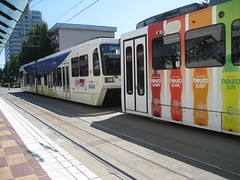
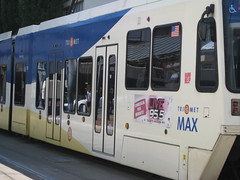
[Portland light rail train near convention center. Hardly any wait and just a few free minutes to downtown near the federal courthouse (free tour available), department stores and the cute animal fountains.]
Social Media Meets Depressing Transit Choices
In a story of partnering with the public to decide how to make up for revenue shortfalls and inevitable service reductions or fare increases, the Oregonian reports that Portland's TriMet transit agency is asking residents to offer their opinions about how to plug a budget hole of $17 million. The article is entitled Want to tell TriMet how to run a railroad (and buses)? Now's your chance, about a social media campaign survey that is more like a game.
The "game" is available at trimet.org/mailforms/budgetchoices.
Can I Borrow Your Car?
One more Portland story that I think is relevant for rural and suburban areas as well, though probably needs a few kinks worked out, is carsharing that is similar to, but goes beyond asking to borrow a neighbor's car. The Oregonian reports that federal funding, changes to the state's automobile insurance law and a venture by a private company will allow cheap pay-by-the-hour car rentals. Basically, you might be able to borrow - for a fee - the old hatchback down the street that has junk all over the front passenger seat or maybe the neat Audi convertible you admire.
With $1.7 million in federal grant money, California start-up Getaround will debut its personal car-sharing service in February, assuming a test period at the Portland State University campus goes well. The pilot starts on Jan. 1.
My source for the Portland stories is my-ever-reliable source, the TransitWire.
-- Projected population growth between 2000 and 2030 is significant in the southcentral Pennsylvania region.To encourage transit use, county borders must become seamless, the study recommends. A potential market is young adults.
-- The need for more express services, multimodal linkages and park and rides was identified.
-- A common way to pay for fares on different transit systems is essential.
-- Transit is viewed as a choice for the younger generation.
-- Separate funding for inter-county transit service coordination is needed in legislation with local political support.
-- Partnerships with local government and employers are very important for regional transit coordination.
Amenities like wireless Internet on buses, such as Rabbit Transit express buses that run between York and Harrisburg and to Maryland, appeal to younger riders.Source: Study finds need for transit coordination in York region, from the YorkDispatch.com
"It seems the younger generation is more open to mass transit and living a sustainable lifestyle," Heilman said.
[Bus outside Chicago's Union Station.]
Texas Partnerships Moving Forward
A disability navigator in Corpus Christi, Tex., a member of the new LinkedIn group for the Partnership for Mobility Management, sent information about his region's experience with the Accessible Transportation Coalitions Initiative, a project of Easter Seals Project ACTION. The ATCI team became the Stakeholder Advisory Committee for the Mobility Options Project, a
Coastal Bend Center for Independent Living demonstration project, funded by a JARC grant from Texas Department of Transportation that:
partners with Workforce Solutions of the Coastal Bend and the Department of Assistive and Rehabilitation Services to increase mobility options for people with disabilities seeking employment-related opportunities. The two-year Mobility Options Project advances the plan developed at the ATCI event primarily regarding increasing access for people with disabilities in rural area, and expanding hours and days of service. To further promote new initiatives in their community that promote the team’s priorities, the ACCESS TEAM advocated for the Corpus Christi Regional Transportation Authority’s successful application for funding through the Department of Transportation’s Veterans Transportation and Community Living Initiative. This initiative will support the development of a regional call center that will provide a single point of access for regional transportation.The team hosted a mobility management summit in the fall and discussed creation of a "united mobility management system" by examining "the positive and negative aspects of three models of mobility management: human services/independent living-based, workforce development-based, and public transit system-based."
[Portland light rail train near convention center. Hardly any wait and just a few free minutes to downtown near the federal courthouse (free tour available), department stores and the cute animal fountains.]
Social Media Meets Depressing Transit Choices
In a story of partnering with the public to decide how to make up for revenue shortfalls and inevitable service reductions or fare increases, the Oregonian reports that Portland's TriMet transit agency is asking residents to offer their opinions about how to plug a budget hole of $17 million. The article is entitled Want to tell TriMet how to run a railroad (and buses)? Now's your chance, about a social media campaign survey that is more like a game.
The site is part poll and part make-painful-choices game. "Love Connection" it's not. Think "Wheel of Fortune" meets a version of the "Sims" video game that allows players to manage a transit agency. There's a red bar reading "$17 million." You control a green bar, which moves depending on whatever service cuts and fare changes you click on. The goal is to balance the green and red.
... ... ... ...
(Yes, TriMet riders and payroll tax payers, it may be the most depressing interactive survey you've ever taken.)
"We're hoping to get an idea of what the public sees as the best approach," said TriMet General Manager Neil McFarlane. "We also want to help people understand the tough tradeoffs that the agency faces."
The "game" is available at trimet.org/mailforms/budgetchoices.
Can I Borrow Your Car?
One more Portland story that I think is relevant for rural and suburban areas as well, though probably needs a few kinks worked out, is carsharing that is similar to, but goes beyond asking to borrow a neighbor's car. The Oregonian reports that federal funding, changes to the state's automobile insurance law and a venture by a private company will allow cheap pay-by-the-hour car rentals. Basically, you might be able to borrow - for a fee - the old hatchback down the street that has junk all over the front passenger seat or maybe the neat Audi convertible you admire.
With $1.7 million in federal grant money, California start-up Getaround will debut its personal car-sharing service in February, assuming a test period at the Portland State University campus goes well. The pilot starts on Jan. 1.
My source for the Portland stories is my-ever-reliable source, the TransitWire.
Wednesday, December 7, 2011
Public Participation - Legal Requirement, Resources, TA Providers
What do you as technical assistance providers say when you are asked for advice about public participation aspects of planning, transit development and creating transportation services? What are resources that are written for laypeople? What staff from within our network can assist you and your constituency? This blog post describes some common issues to keep in mind, legal requirements, just a few recommended resources and a list of staff within the TA Provider Network who can help when public participation issues arise.
Legal Requirement
Public involvement is a legal requirement of SAFETEA-LU and is increasingly used at all levels of government to inform official decisions and projects. A successful public consultation process is proactive and provides complete information, timely public notices in relevant media, and opportunities for early and continuous participation. Early issue identification and cooperative solution-building can reduce the potential for conflict later in the process.
Planning for public participation should account for costs, reasonable timelines, and serious consideration of community voices. To stay in communication with community members, organizations and leaders throughout a planning or other process, establish and maintain a list of all parties interested in transportation in the region or in the particular project at issue.
[Mural near Amtrak station in Galesburg, Ill.]
Outreach
The digital divide looms large for community outreach because methods of outreach, particularly use of social media, email and the Internet, will depend on the lifestyles of the community at large and populations within the community. To rely only on social media and the Internet, however, is to ignore rural populations in areas without good Internet access and people who do not use the Internet and social media.
Effective Participation
Guidance for effective participation applies both to those seeking public input and people who wish to contribute their input. It takes a champion, a committed individual, to identify the players and organize and facilitate meetings in a way that others can see the merit of participation.
Community members should coordinate with other individuals, groups and local and regional political leaders. If possible, it is best to reach a unified position because it is more likely result in success than a lone voice. Newspaper editorials and letters, blogs and comments, Facebook, Twitter, and email campaigns can be useful for publicizing a position and gathering support.
Local political representation should be included from the start so that politicians may take ownership (credit) of the idea and guide it to success. It is best to keep politicians informed all the way through the process, as they can be instrumental in moving the projects along.
[Bus serving what will be Denver's renovated Union Station transit hub; right now the bus appears in the middle of the construction site of the station area.]
Channel Your Inner Boy Scout: Be Prepared
Community members should prepare for a public workshop by obtaining the necessary materials and studying each suggested alternative for any given project. As much factual information as possible should be employed to support a position on a project. Data will be more persuasive and credible than an unsupported opinion. Similarly, enumerating specific concerns and providing explicit suggestions for improving a project are likely to be better received than a general statement of opposition.
Effective participation requires knowledge of the planning process and methods of participating that are proven. Community members may attend the meetings of the MPO or other regional body, its board of directors, technical advisory committee (professional staff from the county and larger municipalities), and its citizen advisory council, all of which are open to the public.
Stakeholder Committees: Convening a stakeholder committee is a strategy that is widely used for supplying transit agencies and governmental entities with feedback about proposed projects and changes to service. Some are used from the planning through the implementation stages of specific projects; some are permanent fixtures.
Resources
Coordination: It’s the Law - explains SAFETEA-LU’s public participation legal requirements.
Public Involvement in Transportation Decisionmaking - a course offered by the National Transit Institute (NTI) that discusses public participation and federal requirements.
How to Engage Low-Literacy and Limited-English-Proficiency Populations - excellent resource for including people who either are unable to read well or are not fluent English speakers. Low literacy is generally a marker for low income populations. The report offers a multitude of methods for reaching people who do not read well, including places to go, people to use, and ways to conduct a meeting.
The Do's and Don'ts of Working with Local Communities: Tips for Successful Community-Based Public Meetings - provides a checklist for effectively leading a public meeting.
A Guide to Transportation Planning for Citizens - explains in simple language the planning processes contemplated in federal mandates and how to become involved.
TCRP SYNTHESIS 85: Effective Use of Citizen Advisory Committees for Transit Planning and Operations - a must-read about public involvement via stakeholder committees. Provides a veritable cookbook for residents, political leaders, government personnel, and non-profit staff of all stripes. Descriptions of a range of purposes for the committees, procedures, membership, sizes, and types of projects and project phases for which the committees were utilized.
Including People with Disabilities In Coordinated Transportation Plans - gives a simple explanation of coordinated planning, benefits of coordination, and improving coordinated planning through the involvement of people with disabilities. This Easter Seals Project ACTION brief includes resources for facilitating the process of coordination.
Contacts
For information about reaching people in rural areas or places where many people are not connected to the Internet, contact Kelly Shawn (shawn@ctaa.org, 202-299-6596).
Remember that including people with disabilities means outreach that is accessible to those populations. Contact Ken Thompson (kthompson@easterseals.com, 800-659-6428) for more information about including people with disabilities.
Convening public meetings and stakeholder groups to discuss issues that will require supporting technology has been a key component of the Mobility Services for All Americans (MSAA) project. For more information, contact Yehuda Gross (yehuda.gross@dot.gov, 202-366-1988).
Contact Sheryl Gross-Glaser (grossglaser@ctaa.org, 202-386-1669) at the National Resource Center for Human Service Transportation Coordination for more information.
Legal Requirement
Public involvement is a legal requirement of SAFETEA-LU and is increasingly used at all levels of government to inform official decisions and projects. A successful public consultation process is proactive and provides complete information, timely public notices in relevant media, and opportunities for early and continuous participation. Early issue identification and cooperative solution-building can reduce the potential for conflict later in the process.
Planning for public participation should account for costs, reasonable timelines, and serious consideration of community voices. To stay in communication with community members, organizations and leaders throughout a planning or other process, establish and maintain a list of all parties interested in transportation in the region or in the particular project at issue.
[Mural near Amtrak station in Galesburg, Ill.]
Outreach
The digital divide looms large for community outreach because methods of outreach, particularly use of social media, email and the Internet, will depend on the lifestyles of the community at large and populations within the community. To rely only on social media and the Internet, however, is to ignore rural populations in areas without good Internet access and people who do not use the Internet and social media.
Effective Participation
Guidance for effective participation applies both to those seeking public input and people who wish to contribute their input. It takes a champion, a committed individual, to identify the players and organize and facilitate meetings in a way that others can see the merit of participation.
Community members should coordinate with other individuals, groups and local and regional political leaders. If possible, it is best to reach a unified position because it is more likely result in success than a lone voice. Newspaper editorials and letters, blogs and comments, Facebook, Twitter, and email campaigns can be useful for publicizing a position and gathering support.
Local political representation should be included from the start so that politicians may take ownership (credit) of the idea and guide it to success. It is best to keep politicians informed all the way through the process, as they can be instrumental in moving the projects along.
[Bus serving what will be Denver's renovated Union Station transit hub; right now the bus appears in the middle of the construction site of the station area.]
Channel Your Inner Boy Scout: Be Prepared
Community members should prepare for a public workshop by obtaining the necessary materials and studying each suggested alternative for any given project. As much factual information as possible should be employed to support a position on a project. Data will be more persuasive and credible than an unsupported opinion. Similarly, enumerating specific concerns and providing explicit suggestions for improving a project are likely to be better received than a general statement of opposition.
Effective participation requires knowledge of the planning process and methods of participating that are proven. Community members may attend the meetings of the MPO or other regional body, its board of directors, technical advisory committee (professional staff from the county and larger municipalities), and its citizen advisory council, all of which are open to the public.
Stakeholder Committees: Convening a stakeholder committee is a strategy that is widely used for supplying transit agencies and governmental entities with feedback about proposed projects and changes to service. Some are used from the planning through the implementation stages of specific projects; some are permanent fixtures.
Resources
Coordination: It’s the Law - explains SAFETEA-LU’s public participation legal requirements.
Public Involvement in Transportation Decisionmaking - a course offered by the National Transit Institute (NTI) that discusses public participation and federal requirements.
How to Engage Low-Literacy and Limited-English-Proficiency Populations - excellent resource for including people who either are unable to read well or are not fluent English speakers. Low literacy is generally a marker for low income populations. The report offers a multitude of methods for reaching people who do not read well, including places to go, people to use, and ways to conduct a meeting.
The Do's and Don'ts of Working with Local Communities: Tips for Successful Community-Based Public Meetings - provides a checklist for effectively leading a public meeting.
A Guide to Transportation Planning for Citizens - explains in simple language the planning processes contemplated in federal mandates and how to become involved.
TCRP SYNTHESIS 85: Effective Use of Citizen Advisory Committees for Transit Planning and Operations - a must-read about public involvement via stakeholder committees. Provides a veritable cookbook for residents, political leaders, government personnel, and non-profit staff of all stripes. Descriptions of a range of purposes for the committees, procedures, membership, sizes, and types of projects and project phases for which the committees were utilized.
Including People with Disabilities In Coordinated Transportation Plans - gives a simple explanation of coordinated planning, benefits of coordination, and improving coordinated planning through the involvement of people with disabilities. This Easter Seals Project ACTION brief includes resources for facilitating the process of coordination.
Contacts
For information about reaching people in rural areas or places where many people are not connected to the Internet, contact Kelly Shawn (shawn@ctaa.org, 202-299-6596).
Remember that including people with disabilities means outreach that is accessible to those populations. Contact Ken Thompson (kthompson@easterseals.com, 800-659-6428) for more information about including people with disabilities.
Convening public meetings and stakeholder groups to discuss issues that will require supporting technology has been a key component of the Mobility Services for All Americans (MSAA) project. For more information, contact Yehuda Gross (yehuda.gross@dot.gov, 202-366-1988).
Contact Sheryl Gross-Glaser (grossglaser@ctaa.org, 202-386-1669) at the National Resource Center for Human Service Transportation Coordination for more information.
Thursday, December 1, 2011
You All Work Very Hard
I don't even know where to begin with news,events, and resources because the TA Provider Network is such a busy crew that I am starting to feel like keeping up is about as possible as being on the candy assembly line with Lucy and Ethel. They keep on going because you of the importance of their work and the need to provide assistance to states, communities, regions, human services agencies, and transit and transportation providers, among others.
I therefore sincerely apologize for the long blog post. These are are all indicative and good examples of the work technical assistance staff produce and how they can assist clients with the resources of TA peers.
[Part of the already-realized multi-modal Denver Union Station project. Exciting at day's end to see all of the commuters and ongoing construction. Thank you to MTAP for the tour.]
New Dialogue and Mobility Management
National Center on Senior Transportation
Online dialogue - Nov. 28 to Dec. 16, 2011 - Intended for individuals and organizations from the aging network and transportation industry. "The dialogue will give the aging network, older adults, advocates, volunteers, policy makers, public and private transportation providers, federal, state, and local transportation agencies, human services agencies, and municipal planning organizations the chance to submit, comment on, and rate ideas related to planning for senior-friendly transportation services." NCST is a technical assistance center administered by Easter Seals Inc., in partnership with the National Association of Area Agencies on Aging.
NCST also has grant money available for mobility management. It is soliciting proposals for senior transportation projects that demonstrate innovative and effective solutions to enhance the mobility of older adults. Funding may be used to create comprehensive mobility management systems, increase mobility in urban and rural areas, and improve public transit access for older persons. The grants will be $50,000 or less. The NCST anticipates making a total of eight awards. These are the categories:
1. Peer-Mobility Management and Employment
2. Mobility Management in Rural/Frontier Areas
3. Mobility Management Integration within Current Practices
4. Mobility Management Applied to the Family of Senior Transportation Options
All proposals must be submitted by December 23, 2011.
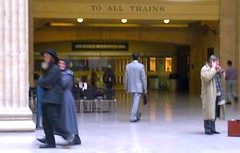
[Chicago's Union Station.]
RTAP Events and New Resource
National Rural Transit Assistance Program
Webinar - Resource Library Overview and Tools - Dec. 5, 2011. The webinar will provide overview of the latest National RTAP web app, the Resource Library. Through National RTAP in the Cloud, this web app can be installed on any transit agency's website and may be used to upload, share and manage resources. You will also learn how you can install the Resource Library web app on your website and use it to upload, share and manage resources. Features of the web app will help you manage, track and report on resources using an easy-to-use web interface.
Conference - Creating Partnerships for Rural Transit Solutions - March 18-21, 2012, Scottsdale, Ariz. The conference will provide technical assistance with RTAP products on four tracks: Tribal, Transit Management, Transit Operations, and RTAP/5311 Program Management.
RTAP releases a new brief, Livable Communities: Tips for Designing Transit Services and Infrastructure that Promote Livability, which explains in simple terms what livability is and what the relationship to and benefits for rural transit are. The brief links to technical assistance resources and federal government information.
What Are the Procurement Rules?
Federal Transit Administration [www.fta.dot.gov]
The FTA has a new page on its site, Third Party Procurement FAQs, which answers questions about a few dozen topics about what procurement rules apply and when. Plus, the sleek look of the FTA site is worth a visit if you have not gone there in a while.
[Galesburg, Ill. train station platform.]
State Coordinating Council Profiles
National Conference of State Legislatures
NCSL has added to its State Human Service Transportation Coordinating Councils: State Profiles. These are in-depth examinations, approximately five to 10 pages, of how the state coordinating councils were created, their goals and evolution, how their objectives are being addressed across the state, and funding details. So far, NCSL's library includes five states.
NCSL also releases a livability brief. Though titled Recent State Livability Initiatives in Minnesota: An Analysis, the brief very much explains the integrated components that comprise livability and the type of projects that fall under its umbrella.
Wayfinding
Easter Seals Project ACTION
ESPA releases a brief about technology to assist people who are visually impaired. Improving Transit Facility Accessibility by Employing Wayfinding Technology discusses tactile maps, detectable warnings, talking signs, smartphone apps and other assistive technology that enables a visually impaired person to navigate streets and transit on his or her own.
Information & Referral Training
National Association of States United for Aging and Disabilities
Online training - Basic Training for Aging I&R/A Professionals - This training will give an overview of the broad array of health, social, and long-term services and supports for seniors and individuals with disabilities; tools and strategies to provide culturally appropriate services; and the fundamental phases of the I&R/A process with a focus on learning how to support the decision making of seniors, individuals with disabilities, and their caregivers.
[Photo taken in California from the Coast Starlight train. I was mesmerized by the landscape.]
Local Story
The transit authority in Wichita, KS, is serving a reduced ridership following a 50-cent fare increase. The authority, in response, is soliciting feedback via an
The fare increase was due to a budget shortfall.
I therefore sincerely apologize for the long blog post. These are are all indicative and good examples of the work technical assistance staff produce and how they can assist clients with the resources of TA peers.
[Part of the already-realized multi-modal Denver Union Station project. Exciting at day's end to see all of the commuters and ongoing construction. Thank you to MTAP for the tour.]
New Dialogue and Mobility Management
National Center on Senior Transportation
Online dialogue - Nov. 28 to Dec. 16, 2011 - Intended for individuals and organizations from the aging network and transportation industry. "The dialogue will give the aging network, older adults, advocates, volunteers, policy makers, public and private transportation providers, federal, state, and local transportation agencies, human services agencies, and municipal planning organizations the chance to submit, comment on, and rate ideas related to planning for senior-friendly transportation services." NCST is a technical assistance center administered by Easter Seals Inc., in partnership with the National Association of Area Agencies on Aging.
NCST also has grant money available for mobility management. It is soliciting proposals for senior transportation projects that demonstrate innovative and effective solutions to enhance the mobility of older adults. Funding may be used to create comprehensive mobility management systems, increase mobility in urban and rural areas, and improve public transit access for older persons. The grants will be $50,000 or less. The NCST anticipates making a total of eight awards. These are the categories:
1. Peer-Mobility Management and Employment
2. Mobility Management in Rural/Frontier Areas
3. Mobility Management Integration within Current Practices
4. Mobility Management Applied to the Family of Senior Transportation Options
All proposals must be submitted by December 23, 2011.
[Chicago's Union Station.]
RTAP Events and New Resource
National Rural Transit Assistance Program
Webinar - Resource Library Overview and Tools - Dec. 5, 2011. The webinar will provide overview of the latest National RTAP web app, the Resource Library. Through National RTAP in the Cloud, this web app can be installed on any transit agency's website and may be used to upload, share and manage resources. You will also learn how you can install the Resource Library web app on your website and use it to upload, share and manage resources. Features of the web app will help you manage, track and report on resources using an easy-to-use web interface.
Conference - Creating Partnerships for Rural Transit Solutions - March 18-21, 2012, Scottsdale, Ariz. The conference will provide technical assistance with RTAP products on four tracks: Tribal, Transit Management, Transit Operations, and RTAP/5311 Program Management.
RTAP releases a new brief, Livable Communities: Tips for Designing Transit Services and Infrastructure that Promote Livability, which explains in simple terms what livability is and what the relationship to and benefits for rural transit are. The brief links to technical assistance resources and federal government information.
What Are the Procurement Rules?
Federal Transit Administration [www.fta.dot.gov]
The FTA has a new page on its site, Third Party Procurement FAQs, which answers questions about a few dozen topics about what procurement rules apply and when. Plus, the sleek look of the FTA site is worth a visit if you have not gone there in a while.
[Galesburg, Ill. train station platform.]
State Coordinating Council Profiles
National Conference of State Legislatures
NCSL has added to its State Human Service Transportation Coordinating Councils: State Profiles. These are in-depth examinations, approximately five to 10 pages, of how the state coordinating councils were created, their goals and evolution, how their objectives are being addressed across the state, and funding details. So far, NCSL's library includes five states.
NCSL also releases a livability brief. Though titled Recent State Livability Initiatives in Minnesota: An Analysis, the brief very much explains the integrated components that comprise livability and the type of projects that fall under its umbrella.
Wayfinding
Easter Seals Project ACTION
ESPA releases a brief about technology to assist people who are visually impaired. Improving Transit Facility Accessibility by Employing Wayfinding Technology discusses tactile maps, detectable warnings, talking signs, smartphone apps and other assistive technology that enables a visually impaired person to navigate streets and transit on his or her own.
Information & Referral Training
National Association of States United for Aging and Disabilities
Online training - Basic Training for Aging I&R/A Professionals - This training will give an overview of the broad array of health, social, and long-term services and supports for seniors and individuals with disabilities; tools and strategies to provide culturally appropriate services; and the fundamental phases of the I&R/A process with a focus on learning how to support the decision making of seniors, individuals with disabilities, and their caregivers.
[Photo taken in California from the Coast Starlight train. I was mesmerized by the landscape.]
Local Story
The transit authority in Wichita, KS, is serving a reduced ridership following a 50-cent fare increase. The authority, in response, is soliciting feedback via an
interactive website to learn more about the public’s needs. The virtual town hall seeks community input about public services. The site provides a convenient way for residents to share ideas, offer opinions and make recommendations on a broad variety of Transit subjects including routes, services and possible expansion plans.
The fare increase was due to a budget shortfall.
Labels:
Accessibility,
Coordination,
Easter Seals Project ACTION,
Events,
FTA,
Livability,
Mobility Management,
NCSL,
NCST,
RTAP
Friday, October 14, 2011
Upcoming Events & Training; Local Perspectives on Livability
Federal Transit Administration
FTA has upcoming listening sessions and webinars about civil rights and environmental justice. The listening sessions will discuss the proposed circulars about those topics.
National Transit Institute
Strollers, Carts, and Other Large Items on Buses and Trains (TCRP Synthesis 88) - webinar - Nov. 17, 2011. This webinar will highlight practices implemented by transit agencies to manage the capacity on vehicles carrying customers with large items, including wheelchairs; Segways; scooters and other mobility aids; strollers; bicycles; luggage, and miscellaneous items, such as skis and dog carriers. A review of the various types of transit vehicles and modifications agencies have made to their vehicles to accommodate large items will be discussed.
Managing Community Mobility - various dates to March 2012.
Comprehensive ADA Paratransit Eligibility - various dates to March 2012.
Community Transportation Association of America
CTAA Train-the-trainer for driver training, safety and security, and transportation solutions coordinator work. Visit CTAA's training page for more information.
Easter Seals Project ACTION
Accessible Transportation Coalitions Initiative - currently accepting applications. ESPA will select 10 communities through a competitive application process to participate. ATCI is a systems change model designed to improve accessible transportation options for people with disabilities. Selected communities will receive on-site facilitation and targeted technical assistance during a two-day event to learn the ATCI model and develop an accessible transportation plan. ESPA will continue to provide targeted technical assistance over the subsequent year while communities implement this plan.
[Portland light rail station with biker waiting for the train.]
Misconceptions about Livability
A new report from the Federal Highway Administration (FHWA) looks at perceived barriers to livability projects in rural, tribal and other types of areas. The Regional Livability Workshops report summarizes five workshops held across the country and suggests strategies
"to raise awareness of transportation linkages to livability, and to provide resources to practitioners and the public to more effectively consider livability issues within the Federal transportation planning process."
Livability TA
Environmental Protection Agency
EPA’s fall 2011 Request for Letters of Interest (PDF: http://www.epa.gov/smartgrowth/pdf/buildingblocks_2011_rfli.pdf) for direct assistance from the agency is now open. EPA will be accepting letters of interest for the next round of Building Blocks for Sustainable Communities from September 28 to October 28, 2011. Subsequent application periods will depend on budget constraints and will be announced on the Smart Growth page.
Local Stories
Twitter brings interesting stories to me and succinctly exposes my brain to useful and inexpensive tools for transit and other mobility options. This article from the Tennessean, More Cyclists, Walkers Counted in Middle TN, demonstrates that a cheap, volunteer tool can provide a snapshot of how people travel at what locations. Since a pedestrian-friendly street network is essential to transit, a one-day audit in a Tennessee community supplied useful information about where people are willing to walk and bike. Although biking is not an option for many handicapped individuals and is not a preference for many others, the bicycling rate is an indicator of how safe the street network feels to non-auto users.
Th Broome County, New York area (Binghamton area) is creating a one-call transportation center. This week, CTAA hosted a Transportation Solutions training, which was covered in the local news. The Broome-Tioga Mobility Management Project (BTMMP) call center will be housed at the local United Way. The BTMMP partnership was created to help meet the need for increased transportation services in both Broome and Tioga Counties. BTMMP will help those in need to arrange and coordinate transportation using all available resources. The BTMMP partners have been planning the project since December 2010.
Food for thought: One thing I noticed in reading a local article about transportation options desired in a rural community was that the meeting to air the community's wish list was taking place on a weekday morning during traditional work hours. Well-organized advocates and staff of government organizations were expected. No mention was made of remote access or feedback or why a time that would exclude most working people would be chosen.
[Portland light rail on a Saturday morning.]
FTA has upcoming listening sessions and webinars about civil rights and environmental justice. The listening sessions will discuss the proposed circulars about those topics.
National Transit Institute
Strollers, Carts, and Other Large Items on Buses and Trains (TCRP Synthesis 88) - webinar - Nov. 17, 2011. This webinar will highlight practices implemented by transit agencies to manage the capacity on vehicles carrying customers with large items, including wheelchairs; Segways; scooters and other mobility aids; strollers; bicycles; luggage, and miscellaneous items, such as skis and dog carriers. A review of the various types of transit vehicles and modifications agencies have made to their vehicles to accommodate large items will be discussed.
Managing Community Mobility - various dates to March 2012.
Comprehensive ADA Paratransit Eligibility - various dates to March 2012.
Community Transportation Association of America
CTAA Train-the-trainer for driver training, safety and security, and transportation solutions coordinator work. Visit CTAA's training page for more information.
Easter Seals Project ACTION
Accessible Transportation Coalitions Initiative - currently accepting applications. ESPA will select 10 communities through a competitive application process to participate. ATCI is a systems change model designed to improve accessible transportation options for people with disabilities. Selected communities will receive on-site facilitation and targeted technical assistance during a two-day event to learn the ATCI model and develop an accessible transportation plan. ESPA will continue to provide targeted technical assistance over the subsequent year while communities implement this plan.
[Portland light rail station with biker waiting for the train.]
Misconceptions about Livability
A new report from the Federal Highway Administration (FHWA) looks at perceived barriers to livability projects in rural, tribal and other types of areas. The Regional Livability Workshops report summarizes five workshops held across the country and suggests strategies
"to raise awareness of transportation linkages to livability, and to provide resources to practitioners and the public to more effectively consider livability issues within the Federal transportation planning process."
While most communities do have a set of goals or vision statements, workshop participants noted that the most effective visions are those that emerge from a collaborative visioning, planning or scenario development process. Participants noted quite often, these efforts include a strong outreach process that brings together both multidisciplinary interests as well as public and private constituencies. These processes can spur lasting relationships and coalitions that ultimately help create local keepers of the vision. It was also noted when a strong vision is present, project prioritization and project delivery methods can demonstrate clear policy choices between various alternatives. This direct link helps foster identification and implementation of transportation investments in support of community goals.
Community goals reflect the unique character, values, and priorities of a given place. Participants discussed the need to better align regional, State or Federal goals in transportation and mobility with local community goals. One strategy includes documenting existing goals at each level (Federal, State, regional and local) or across differing agencies and identifying where commonalities or conflicts exist. This can help to understand the tradeoffs or policy issues that need to be considered to more effectively align transportation priorities with local livability goals.
Livability TA
Environmental Protection Agency
EPA’s fall 2011 Request for Letters of Interest (PDF: http://www.epa.gov/smartgrowth/pdf/buildingblocks_2011_rfli.pdf) for direct assistance from the agency is now open. EPA will be accepting letters of interest for the next round of Building Blocks for Sustainable Communities from September 28 to October 28, 2011. Subsequent application periods will depend on budget constraints and will be announced on the Smart Growth page.
Local Stories
Twitter brings interesting stories to me and succinctly exposes my brain to useful and inexpensive tools for transit and other mobility options. This article from the Tennessean, More Cyclists, Walkers Counted in Middle TN, demonstrates that a cheap, volunteer tool can provide a snapshot of how people travel at what locations. Since a pedestrian-friendly street network is essential to transit, a one-day audit in a Tennessee community supplied useful information about where people are willing to walk and bike. Although biking is not an option for many handicapped individuals and is not a preference for many others, the bicycling rate is an indicator of how safe the street network feels to non-auto users.
Th Broome County, New York area (Binghamton area) is creating a one-call transportation center. This week, CTAA hosted a Transportation Solutions training, which was covered in the local news. The Broome-Tioga Mobility Management Project (BTMMP) call center will be housed at the local United Way. The BTMMP partnership was created to help meet the need for increased transportation services in both Broome and Tioga Counties. BTMMP will help those in need to arrange and coordinate transportation using all available resources. The BTMMP partners have been planning the project since December 2010.
BTMMP is a multi-agency partnership funded in part by the Community Foundation for South Central New York; the AmeriCorps National Service Program; Tioga Transport, Inc.; and with in-kind contributions from BTMMP partner organizations.
Food for thought: One thing I noticed in reading a local article about transportation options desired in a rural community was that the meeting to air the community's wish list was taking place on a weekday morning during traditional work hours. Well-organized advocates and staff of government organizations were expected. No mention was made of remote access or feedback or why a time that would exclude most working people would be chosen.
[Portland light rail on a Saturday morning.]
Labels:
Community Participation,
CTAA,
Easter Seals Project ACTION,
FHWA,
FTA,
Livability,
NTI
Thursday, September 1, 2011
Webinars and Events
Performing For Individual, Organizational and Collective Impact - webinar - Sept. 14, 2011 at 2 p.m. Eastern time. The Partnership for Mobility Management and CTAA jointly present this webinar to explore the fundamentals of performance measurement. The webinar will cover results-based accountability to support quality of life, and mobility management measures that gauge success of programs and outcomes for customers.
Creative Solutions to Reduced Funding for Public and Human Services Transportation - webinar - Sept. 20, 2011 at 2 p.m. Eastern time. Webinar speakers are representatives of communities that have taken different approaches to solving or alleviating the problem of cutbacks as well as a panel representing national organizations.
Digital Transportation Exchange (DTE) - Stakeholder meeting in-person or via webcast or phone - Sept. 16, 2011 at 9 a.m. Eastern time. DTE is being created by DOT as an online platform for transportation
solutions. The stakeholder meeting is taking place during the platform's formation to give DOT feedback from stakeholder groups and
subject matter experts. Respond by tomorrow, September 2, by email to open@dot.gov and indicate how you intend to participate.
Thank you to Easter Seals Project ACTION for this news.
[Angel's Flight railway in downtown Los Angeles.]
[Angel's Flight railway in downtown Los Angeles.]
Office of Civil Rights Workshop - Sept. 22-23, 2011, Berkeley, CA. FTA Staff will be available to review DBE Goals and Title VI & Limited English Proficiency (LEP) Programs. There will also be trainings covering Disadvantaged Business Enterprise (DBE) program requirements, Equal Employment Opportunity (EEO) regulations, Title VI Requirements for FTA recipients, and Limited English Proficiency (LEP) rules. (This workshop will be hosted in conjunction with the California Association of Coordinated Transportation (CalACT) Autumn Conference. It is not required to attend the CalACT Autumn Conference in order to attend the FTA Office of Civil Rights workshop.)
NTI has upcoming webinars and classes around the country on many topics, including the National Transit Database, reporting to the rural transit database, mobility management, funding for transit maintenance, and small systems waivers.
Monday, January 24, 2011
Disability Community - Resources for Making Transit a Better Fit
Department of Labor, Employment and Training Administration (ETA)
ETA has created the Disability and Employment Community of Practice. A search of the website produces many of the disability and employment-transportation resources from the TA network. The site is focusing on resources for employers and access and accommodations. The group is looking for members with professional interests in this field.
Easter Seals Project ACTION (ESPA)
ESPA has two upcoming teleconferences. Deviated Fixed Route and Demand Response Service: Creating Solutions in Rural and Small Urban Communities will take place on February 16. The teleconference will focus on the importance of a strong connection between transit and disability groups.
Planning for the Accessibility of Livable and Sustainable Communities, to be held on March 9, will feature representatives from the Department of Transportation discussing the encouragement of community connections to housing, employment and economic development through accessible transportation. A representative from Peoria, Ill. will discuss the city’s plans to redevelop a downtown area using the principles of livability and the role that accessibility plays in the development of those plans.
ESPA continues its Introduction to Travel Training course, a free training initiative that aims to increase the skills, knowledge and abilities of travel training professionals. This intensive, three-day course includes both classroom and field instruction in an environment where travel trainers can directly apply and practice new skills on the street. The next course will be held March 15-17 in Los Angeles, Calif.
ETA has created the Disability and Employment Community of Practice. A search of the website produces many of the disability and employment-transportation resources from the TA network. The site is focusing on resources for employers and access and accommodations. The group is looking for members with professional interests in this field.
Easter Seals Project ACTION (ESPA)
ESPA has two upcoming teleconferences. Deviated Fixed Route and Demand Response Service: Creating Solutions in Rural and Small Urban Communities will take place on February 16. The teleconference will focus on the importance of a strong connection between transit and disability groups.
Planning for the Accessibility of Livable and Sustainable Communities, to be held on March 9, will feature representatives from the Department of Transportation discussing the encouragement of community connections to housing, employment and economic development through accessible transportation. A representative from Peoria, Ill. will discuss the city’s plans to redevelop a downtown area using the principles of livability and the role that accessibility plays in the development of those plans.
ESPA continues its Introduction to Travel Training course, a free training initiative that aims to increase the skills, knowledge and abilities of travel training professionals. This intensive, three-day course includes both classroom and field instruction in an environment where travel trainers can directly apply and practice new skills on the street. The next course will be held March 15-17 in Los Angeles, Calif.
Tuesday, December 7, 2010
2010 Highlights
I am starting the recap early this year, going over notes, my blog, the index of my old newsletter, and thinking about what from 2010 resonates and will last as useful resources and information as the calendar page turns over to 2011.
Wishing you and your loved ones a happy and a healthy holiday season and a joyous new year.
Stay Up to Date at the National Resource Center for Human Service Transportation Coordination
Go to the NRC website - www.NRCtransportation.org - for news and information from around the country, such as the blogs of the United We Ride Ambassadors. The NRC also has resources about all aspects of public and human services transportation, including several compilations about significant topics.
New News Sources
The Association for Commuter Transportation (ACT) has launched a newsletter, Caryn's Corner, named for Executive Director Caryn Souza.
The National Conference of State Legislatures (NCSL)created two transportation-related newsletters, one is the Transportation Coordination Quarterly Newsletter, a compilation of news and resources involving coordination, and the other a monthly newsletter that spans transportation sectors.
Specialized Taxi Transportation
In 2010, the Taxi, Limousine, and Paratransit Association (TLPA) prepared reports that address the taxi industry's role in providing non-emergency medical transportation and accessible transportation. These are Assessing the Full Cost of Implementing An Accessible Taxicab Program and Non-Emergency Medicaid Transportation (NEMT): How to Maximize Safety and Cost Effectiveness
Through Better Use of Private For-Hire Vehicle Operators. The accessible transportation report discusses how the taxi industry works in terms of the practical obstacles and costs of providing accessibility where the additional costs fall on mostly small businesses and independent contractors. The NEMT report provides an excellent explanation of what coordination provides and what models of NEMT exist throughout the country.
Learning about Health Care Changes
For information on what states must accomplish and are doing to fulfill the mandates of the new health care law, the National Governors' Association (NGA) has created a website, the Health Reform Implementation Resource Center, a product of the State Consortium on Health Care Reform Implementation (State Consortium), which provides information and technical assistance to states about requirements, offers options and best practices and synthesizes feedback to federal agencies on issues that affect state implementation. The website has resources on aspects of the health reform law that are likely to have the biggest effect on states – the Medicaid expansion, the establishment of health insurance exchanges, insurance regulations, and delivery system initiatives, along with important governance, coordination and timing issues for states are available from NGA and on each of the Consortium members' websites.
The American Public Human Services Association (APHSA) has a short presentation, Health Reform: Issues for State Governments, that explains the effective dates of different provisions, what will happen to Medicaid, and summarizes long-term care and other provisions.
With greater numbers of people to be covered by Medicaid and preventive and maintenance medicine to be practiced, there may well be many more people traveling to regular doctor appointments. The Community Transportation Association of America is assisting providers with training, the Competitive Edge, to enable providers to be more efficient for when the new law takes effect.
Transportation for Challenged Populations
The American Public Transportation Association (APTA) report, Funding the Public Transportation Needs of an Aging Population, discusses the depth of the growing need for transportation services among Older Americans and the amounts of funding that will be necessary to provide those services. In addition to APTA, the report was guided by input from a technical working group that included CTAA, Easter Seals Project ACTION, and the AARP Public Policy Institute, all members of the National Consortium on the Coordination of Human Services Transportation.
The Federal Transit Administration (FTA) has a multitude of resources related to the intersection of transit and the ADA. These include regulations, legal guidance, details about equipment and paratransit eligibility, and so much more. A new page has topic guides on selected ADA topics.
The Easter Seals Project ACTION website always has resources for government staff, transportation providers and transportation-challenged populations. These resources offer information to improve services, educate staff and enhance public participation.
Census Guides the Future
Census 2010 and Transit: What's at stake? is a web portal that the NRC created for transit-related Census resources. The 2010 Census will help communities receive over $400 billion in federal funds each year for many activities including transit and human services. Visit the NRC's Census 2010 page to read about how public transportation may be affected, learn about possible outcomes for tribal communities, and find a list of quick links to audio and video clips about the Census.
State-Level Sustainability Plans
State-wide sustainability and livability movements are turning into established parts of state governments with plans that span different sectors of the economy and public works, including transportation. At their core, these plans envision transportation systems that meet present needs without compromising the lifestyles of future generations.
Hawaii's plan, Hawaii 2050, incorporates increased public transportation as a goal and an indicator of progress under its community and social well-being heading. Hawaii's plan goes way beyond the environment, addressing such different issues as the economy, education and health care.
The Department of Transportation for Washington, D.C., the equivalent of a state department of transportation that also has jurisdiction over local roads, releases its Sustainability Plan 2010, which promotes transit, biking and walking and seeks to reduce energy consumption.
The Oregon Department of Transportation also has a sustainability plan. It emphatically incorporates public transportation and the environmental and health benefits of zero and low-emission modes. The state DOT also commits to a policy of locating its own facilities in places that employees can reach by walking and transit.
State Planning Participation
The National Association of Development Organizations (NADO), via its Rural Transportation Clearinghouse, posted a presentation that local officials can use or modify for orientation of new board members, transportation committee members or staff. The Guide for Rural Local Officials: Evaluating Your Input into the Statewide Transportation Planning Process explained the local role in state transportation planning across modes. The guide was also available in a PowerPoint format.
NADO also released a new online version of its Metropolitan and Rural Transportation Planning: Case Studies and Checklists for Regional Collaboration. This guide was intended for leadership and professional staff of metropolitan planning organizations (MPOs), rural planning organizations (RPOs), state departments of transportation (DOTs), and regional development organizations that are involved in transportation planning, programming, and service delivery, and other planning partners.
The Federal Highway Administration (FHWA) has released an MPO primer, Staffing and Administrative Capacity of Metropolitan Planning Organizations. It is a terrific nuts and bolts detailed description of Metropolitan Planning Organizations (MPOs), their staffs, projects, funding, partnerships and formal arrangements with state and local governments.
Livability and Sustainability
The Initiative for Sustainable Communities and States (ISCS) compiles the news and resources of the federal interagency sustainability partnership in one place. There is information about funding, policy, and examples for states and localities.
The American Association of State Highway and Transportation Officials (AASHTO) has a Transportation and Climate Change Resource Center with resources about how state departments of transportation, regional planning organizations and states are addressing climate change.
Always a solid source is the FTA's livability page, which is kept up to date with funding programs, case studies, and news and links related to the interagency sustainability partnership.
Also on My Favorites List
TCRP SYNTHESIS 85: Effective Use of Citizen Advisory Committees for Transit Planning and Operations is a must-read for anyone who either works with public involvement and stakeholder groups, recommends them, or whose work is in some way involves public involvement.
TCRP Report 140: A Guide for Planning and Operating Flexible Public Transportation Services, a product of the Transit Cooperative Research Program, gets into the weeds on what constitutes a non-fixed route, flexible transit service, why communities and regions choose them, the relative costs and how they operate either on their own or as supplements to traditional fixed route and ADA paratransit service.
Compilation of tribal transit resources, which appeared on this page earlier in the year.
An Express Stop blog post offers a compendium of emergency preparedness resources.
Relevant to public employees and citizens in every state is a National Conference of State Legislatures (NCSL) Fiscal Brief: State Balanced Budget Provisions, which explains what is meant by a balanced budget, to which funds state constitutional and statutory provisions apply and what enforcement mechanisms exist. Interesting is how varied balanced budget requirements are. This not a one-size-fits-all term.
Wishing you and your loved ones a happy and a healthy holiday season and a joyous new year.
Stay Up to Date at the National Resource Center for Human Service Transportation Coordination
Go to the NRC website - www.NRCtransportation.org - for news and information from around the country, such as the blogs of the United We Ride Ambassadors. The NRC also has resources about all aspects of public and human services transportation, including several compilations about significant topics.
New News Sources
The Association for Commuter Transportation (ACT) has launched a newsletter, Caryn's Corner, named for Executive Director Caryn Souza.
The National Conference of State Legislatures (NCSL)created two transportation-related newsletters, one is the Transportation Coordination Quarterly Newsletter, a compilation of news and resources involving coordination, and the other a monthly newsletter that spans transportation sectors.
Specialized Taxi Transportation
In 2010, the Taxi, Limousine, and Paratransit Association (TLPA) prepared reports that address the taxi industry's role in providing non-emergency medical transportation and accessible transportation. These are Assessing the Full Cost of Implementing An Accessible Taxicab Program and Non-Emergency Medicaid Transportation (NEMT): How to Maximize Safety and Cost Effectiveness
Through Better Use of Private For-Hire Vehicle Operators. The accessible transportation report discusses how the taxi industry works in terms of the practical obstacles and costs of providing accessibility where the additional costs fall on mostly small businesses and independent contractors. The NEMT report provides an excellent explanation of what coordination provides and what models of NEMT exist throughout the country.
Learning about Health Care Changes
For information on what states must accomplish and are doing to fulfill the mandates of the new health care law, the National Governors' Association (NGA) has created a website, the Health Reform Implementation Resource Center, a product of the State Consortium on Health Care Reform Implementation (State Consortium), which provides information and technical assistance to states about requirements, offers options and best practices and synthesizes feedback to federal agencies on issues that affect state implementation. The website has resources on aspects of the health reform law that are likely to have the biggest effect on states – the Medicaid expansion, the establishment of health insurance exchanges, insurance regulations, and delivery system initiatives, along with important governance, coordination and timing issues for states are available from NGA and on each of the Consortium members' websites.
The American Public Human Services Association (APHSA) has a short presentation, Health Reform: Issues for State Governments, that explains the effective dates of different provisions, what will happen to Medicaid, and summarizes long-term care and other provisions.
With greater numbers of people to be covered by Medicaid and preventive and maintenance medicine to be practiced, there may well be many more people traveling to regular doctor appointments. The Community Transportation Association of America is assisting providers with training, the Competitive Edge, to enable providers to be more efficient for when the new law takes effect.
Transportation for Challenged Populations
The American Public Transportation Association (APTA) report, Funding the Public Transportation Needs of an Aging Population, discusses the depth of the growing need for transportation services among Older Americans and the amounts of funding that will be necessary to provide those services. In addition to APTA, the report was guided by input from a technical working group that included CTAA, Easter Seals Project ACTION, and the AARP Public Policy Institute, all members of the National Consortium on the Coordination of Human Services Transportation.
The Federal Transit Administration (FTA) has a multitude of resources related to the intersection of transit and the ADA. These include regulations, legal guidance, details about equipment and paratransit eligibility, and so much more. A new page has topic guides on selected ADA topics.
The Easter Seals Project ACTION website always has resources for government staff, transportation providers and transportation-challenged populations. These resources offer information to improve services, educate staff and enhance public participation.
Census Guides the Future
Census 2010 and Transit: What's at stake? is a web portal that the NRC created for transit-related Census resources. The 2010 Census will help communities receive over $400 billion in federal funds each year for many activities including transit and human services. Visit the NRC's Census 2010 page to read about how public transportation may be affected, learn about possible outcomes for tribal communities, and find a list of quick links to audio and video clips about the Census.
State-Level Sustainability Plans
State-wide sustainability and livability movements are turning into established parts of state governments with plans that span different sectors of the economy and public works, including transportation. At their core, these plans envision transportation systems that meet present needs without compromising the lifestyles of future generations.
Hawaii's plan, Hawaii 2050, incorporates increased public transportation as a goal and an indicator of progress under its community and social well-being heading. Hawaii's plan goes way beyond the environment, addressing such different issues as the economy, education and health care.
The Department of Transportation for Washington, D.C., the equivalent of a state department of transportation that also has jurisdiction over local roads, releases its Sustainability Plan 2010, which promotes transit, biking and walking and seeks to reduce energy consumption.
The Oregon Department of Transportation also has a sustainability plan. It emphatically incorporates public transportation and the environmental and health benefits of zero and low-emission modes. The state DOT also commits to a policy of locating its own facilities in places that employees can reach by walking and transit.
State Planning Participation
The National Association of Development Organizations (NADO), via its Rural Transportation Clearinghouse, posted a presentation that local officials can use or modify for orientation of new board members, transportation committee members or staff. The Guide for Rural Local Officials: Evaluating Your Input into the Statewide Transportation Planning Process explained the local role in state transportation planning across modes. The guide was also available in a PowerPoint format.
NADO also released a new online version of its Metropolitan and Rural Transportation Planning: Case Studies and Checklists for Regional Collaboration. This guide was intended for leadership and professional staff of metropolitan planning organizations (MPOs), rural planning organizations (RPOs), state departments of transportation (DOTs), and regional development organizations that are involved in transportation planning, programming, and service delivery, and other planning partners.
The Federal Highway Administration (FHWA) has released an MPO primer, Staffing and Administrative Capacity of Metropolitan Planning Organizations. It is a terrific nuts and bolts detailed description of Metropolitan Planning Organizations (MPOs), their staffs, projects, funding, partnerships and formal arrangements with state and local governments.
Livability and Sustainability
The Initiative for Sustainable Communities and States (ISCS) compiles the news and resources of the federal interagency sustainability partnership in one place. There is information about funding, policy, and examples for states and localities.
The American Association of State Highway and Transportation Officials (AASHTO) has a Transportation and Climate Change Resource Center with resources about how state departments of transportation, regional planning organizations and states are addressing climate change.
Always a solid source is the FTA's livability page, which is kept up to date with funding programs, case studies, and news and links related to the interagency sustainability partnership.
Also on My Favorites List
TCRP SYNTHESIS 85: Effective Use of Citizen Advisory Committees for Transit Planning and Operations is a must-read for anyone who either works with public involvement and stakeholder groups, recommends them, or whose work is in some way involves public involvement.
TCRP Report 140: A Guide for Planning and Operating Flexible Public Transportation Services, a product of the Transit Cooperative Research Program, gets into the weeds on what constitutes a non-fixed route, flexible transit service, why communities and regions choose them, the relative costs and how they operate either on their own or as supplements to traditional fixed route and ADA paratransit service.
Compilation of tribal transit resources, which appeared on this page earlier in the year.
An Express Stop blog post offers a compendium of emergency preparedness resources.
Relevant to public employees and citizens in every state is a National Conference of State Legislatures (NCSL) Fiscal Brief: State Balanced Budget Provisions, which explains what is meant by a balanced budget, to which funds state constitutional and statutory provisions apply and what enforcement mechanisms exist. Interesting is how varied balanced budget requirements are. This not a one-size-fits-all term.
Labels:
ADA,
APTA,
CTAA,
Easter Seals Project ACTION,
FHWA,
FTA,
Livability,
NADO,
NCSL,
NEMT,
NRC,
TLPA,
United Way
Wednesday, November 10, 2010
Events and Resources from Around the TA Network
National Transit Institute
The National Transit Institute (NTI)has upcoming classes related to coordination.
Public Involvement in Transportation Decisionmaking
This course will:
* Identify public involvement challenges
* Describe U.S. DOT transportation decision-making processes, including those that trigger the National Environmental Policy Act (NEPA)
* Describe the relationship between public involvement and decisionmaking
* Develop a public involvement plan with stakeholder assistance that includes attention to non-traditional populations as an evaluation component
* Describe interest-based problem solving and their underlying values
* Identify ways to enhance public involvement plans
Public Involvement in Transportation Decisionmaking will be given Dec. 8-10 in Arlington, VA; but check NTI's webpage for the course for future offerings.
Managing Community Mobility
This course will:
* Introduce the concept of mobility management and its application to transportation operations at the community level.
* Identify funding resources available for implementing and operating mobility management programs.
* Describe how to develop the Coordinated Public Transit and Human Service Transportation Plan “Coordinated Plan.”
* Identify the necessary tools and resources to effectively implement a mobility management program.
* Present case studies of successful mobility management models.
* Discuss the skills of a mobility manager.
The course is being held in three different locations from December through April.
Easter Seals Project ACTION
Easter Seals Project ACTION has a new Livable Communities page on its website. Featured are ESPA's publications about accessible streets, transit, and universal design as well as links to government and other resources.
ADA Essentials for Transit Board Members: Fundamentals of the Americans with Disabilities Act and Transit Public Policy, produced with the American Public Transportation Association (APTA), is a primer on transit's responsibility in realizing the goals of the Americans with Disabilities Act (ADA) and the legal obligations that the ADA established. The publication addresses traditional fixed-route service and transit facilities, but does not discuss deviated route or other types of service to which the ADA does not apply. It also provides information about federal transportation initiatives related to the ADA, such as United We Ride.
ESPA is hosting an audio conference, Developing Flexible Policies to Empower Transit and Customers with Disabilities, on Dec. 8. The audio conference will cover modifications to transit policies that enable access by customers with disabilities and legal requirements for modifications to policy. The program will also feature several examples of ways in which flexibility can help create a more accessible transportation experience for customers with disabilities.
Federal Highway Administration (FHWA)
The next Pedestrian Safety Webinar will take place on Tuesday, November 23 from 1:00-3:00 Eastern Time. Learn about pedestrian safety initiatives in New York City and California. For information, go to https://www.nhi.fhwa.dot.gov/resources/webconference/web_conf_learner_reg.aspx?webconfid=21797.
The National Transit Institute (NTI)has upcoming classes related to coordination.
Public Involvement in Transportation Decisionmaking
This course will:
* Identify public involvement challenges
* Describe U.S. DOT transportation decision-making processes, including those that trigger the National Environmental Policy Act (NEPA)
* Describe the relationship between public involvement and decisionmaking
* Develop a public involvement plan with stakeholder assistance that includes attention to non-traditional populations as an evaluation component
* Describe interest-based problem solving and their underlying values
* Identify ways to enhance public involvement plans
Public Involvement in Transportation Decisionmaking will be given Dec. 8-10 in Arlington, VA; but check NTI's webpage for the course for future offerings.
Managing Community Mobility
This course will:
* Introduce the concept of mobility management and its application to transportation operations at the community level.
* Identify funding resources available for implementing and operating mobility management programs.
* Describe how to develop the Coordinated Public Transit and Human Service Transportation Plan “Coordinated Plan.”
* Identify the necessary tools and resources to effectively implement a mobility management program.
* Present case studies of successful mobility management models.
* Discuss the skills of a mobility manager.
The course is being held in three different locations from December through April.
Easter Seals Project ACTION
Easter Seals Project ACTION has a new Livable Communities page on its website. Featured are ESPA's publications about accessible streets, transit, and universal design as well as links to government and other resources.
ADA Essentials for Transit Board Members: Fundamentals of the Americans with Disabilities Act and Transit Public Policy, produced with the American Public Transportation Association (APTA), is a primer on transit's responsibility in realizing the goals of the Americans with Disabilities Act (ADA) and the legal obligations that the ADA established. The publication addresses traditional fixed-route service and transit facilities, but does not discuss deviated route or other types of service to which the ADA does not apply. It also provides information about federal transportation initiatives related to the ADA, such as United We Ride.
ESPA is hosting an audio conference, Developing Flexible Policies to Empower Transit and Customers with Disabilities, on Dec. 8. The audio conference will cover modifications to transit policies that enable access by customers with disabilities and legal requirements for modifications to policy. The program will also feature several examples of ways in which flexibility can help create a more accessible transportation experience for customers with disabilities.
Federal Highway Administration (FHWA)
The next Pedestrian Safety Webinar will take place on Tuesday, November 23 from 1:00-3:00 Eastern Time. Learn about pedestrian safety initiatives in New York City and California. For information, go to https://www.nhi.fhwa.dot.gov/resources/webconference/web_conf_learner_reg.aspx?webconfid=21797.
Labels:
ADA,
APTA,
Coordination,
Easter Seals Project ACTION,
FHWA,
Mobility Management,
NTI
Thursday, August 26, 2010
All About Coordination
Two instances of coordination at the federal level caught my attention. One involves the Administration's current focus on the benefits of its livability initiative for rural America and the other involves the efforts of public health advocates to work with transportation organizations to combat widespread public health problems.
An important aspect of coordination is maintaining the momentum of working with partners over long periods. One of our TA centers is addressing that issue in an upcoming audio conference described below.
USDA Program Features Sustainability Partners
The Community Transportation Association of America (CTAA) participated in the Department of Agriculture's (USDA) roundtable yesterday to discuss livability in rural areas. Among the topics covered was the need for connectivity between rural and urban communities. The roundtable also focused on preserving small town main streets, protecting agriculture and expanding transportation options. Deputy secretaries from DOT and HUD addressed the participants.
Connecting Transportation Options to Health
In September, the Robert Wood Johnson Foundation (RWJF) Childhood Obesity program is starting a webinar series devoted to the connection between transportation policy and the obesity-health issue.
Sept. 9 - "Ready Set Go: Transportation Reauthorization"
Recommendations on how to ensure that investments in transportation are made equitably, so that all children and families have access to safe, reliable, affordable transportation options that encourage healthy, active lifestyles.
Sept. 23 - "Hide and Seek: Where is Your School and How Do You Get There?"
Safe routes to school and school siting guidelines within the framework of broader sustainable community development.
Oct. 7 - "On the Go: Complete Streets and Public Transportation"
Strategies for effective advocacy and implementation of complete streets policies and advice for ensuring that access to public transportation and active living opportunities are equitably provided to all communities.
Oct. 21 - "Feet to the Streets: Alternatives to Motorized Transportation"
Strategies for creating opportunities that encourage non-motorized transportation, particularly walking and biking.
Maintaining Momentum
Easter Seals Project ACTION (ESPA) is having an audio conference, Sustaining Coalition Efforts for Improving Accessible Transportation on Sept. 28. As part of the series Promising Practices and Solutions in Accessible Transportation, ESPA will address re-energizing members to maintain interest and enthusiasm, recognizing small steps toward long-term success, replacing members who move on to other jobs and activities, and reaching consensus among diverse partners.
An important aspect of coordination is maintaining the momentum of working with partners over long periods. One of our TA centers is addressing that issue in an upcoming audio conference described below.
USDA Program Features Sustainability Partners
The Community Transportation Association of America (CTAA) participated in the Department of Agriculture's (USDA) roundtable yesterday to discuss livability in rural areas. Among the topics covered was the need for connectivity between rural and urban communities. The roundtable also focused on preserving small town main streets, protecting agriculture and expanding transportation options. Deputy secretaries from DOT and HUD addressed the participants.
Connecting Transportation Options to Health
In September, the Robert Wood Johnson Foundation (RWJF) Childhood Obesity program is starting a webinar series devoted to the connection between transportation policy and the obesity-health issue.
Sept. 9 - "Ready Set Go: Transportation Reauthorization"
Recommendations on how to ensure that investments in transportation are made equitably, so that all children and families have access to safe, reliable, affordable transportation options that encourage healthy, active lifestyles.
Sept. 23 - "Hide and Seek: Where is Your School and How Do You Get There?"
Safe routes to school and school siting guidelines within the framework of broader sustainable community development.
Oct. 7 - "On the Go: Complete Streets and Public Transportation"
Strategies for effective advocacy and implementation of complete streets policies and advice for ensuring that access to public transportation and active living opportunities are equitably provided to all communities.
Oct. 21 - "Feet to the Streets: Alternatives to Motorized Transportation"
Strategies for creating opportunities that encourage non-motorized transportation, particularly walking and biking.
Maintaining Momentum
Easter Seals Project ACTION (ESPA) is having an audio conference, Sustaining Coalition Efforts for Improving Accessible Transportation on Sept. 28. As part of the series Promising Practices and Solutions in Accessible Transportation, ESPA will address re-energizing members to maintain interest and enthusiasm, recognizing small steps toward long-term success, replacing members who move on to other jobs and activities, and reaching consensus among diverse partners.
Thursday, July 29, 2010
A Meaningful Decision for Employers
I have to admit a liking for a good judicial opinion, especially one well written and intellectually honest. So, when Randee Chafkin alerted her fellow staff at the Coordinating Council on Access and Mobility (CCAM) about an ADA decision related to commuting to work, I did not hesitate to read the whole opinion to glean some helpful hints for transit and transportation providers, employers, advocates and people with disabilities.
The question posed in Colwell v. Rite Aid is whether a disability that does not handicap one in any way at work can be counted as a disability - which requires accommodation - where the only disadvantage is an inability to drive to or from work, in this case at night after the public transit buses stopped running and where taxi service was unavailable.
Procedural Pointers
Colwell does not require that the employer assist with transportation or advocate for improved transportation options. Nor does Colwell speak to other transportation-challenged populations, such as people who temporarily or permanently do not drive due to low income or preference. Presumably it applies to discrimination on the basis of age itself. However, as people with disabilities are overrepresented among low income populations, those with disabilities that make driving dangerous or impossible can glean much from the decision.
Another important tidbit to keep in mind is that Colwell was decided on a summary judgment motion, which is basically the stage where a judge rules, if asked (and the motion is very common), whether the allegations could lead - after a jury trial - to a judgment for the person who is suing. Generally, if the plaintiff wins, the suit settles because going the distance to a trial and perhaps appeals is a time consuming and expensive process.
Shift Request
The plaintiff was a part-time employee in her sixties who developed a serious eye problem in one eye that led to blindness in that eye. She asked her employer, a large chain drugstore, to accommodate her visual disability with assignment to day shifts instead of her usual night shifts. The plaintiff had managed thus far to get rides to work and the employer refused the request. (Other information in the opinion suggested that the manager was none too fond of the plaintiff otherwise.)
The defendant, Rite Aid, argued that the commute to work fell outside of the workplace and therefore commuting difficulties did not require accommodation. The Third Circuit saw the legal landscape very differently. "[W]e hold as a matter of law that changing Colwell’s working schedule to day shifts in order to alleviate her disability-related difficulties in getting to work is a type of accommodation that the ADA contemplates."
Reasonable Accommodation
The ADA's provision for reasonable accommodations, the Third Circuit found, explicitly includes "modified work schedules." "[P]ersons who may require modified work schedules are persons with mobility impairments who depend on a public transportation system that is not currently fully accessible."
And the Court declared flat out that the ADA covers getting to work even though transportation to employment does not involve any accommodation at the workplace.
Refusing to comment on a Second Circuit opinion that held an employer to task for not paying for a parking space for an employee who was unable to walk long distances, the Third Circuit agreed that "T]here is nothing inherently unreasonable, ... in requiring an employer to furnish an otherwise qualified disabled employee with assistance related to her ability to get to work."
Hence, if the plaintiff had lived and worked in an area with evening bus service, Rite Aid would not have had to spend all this money on attorneys and, presumably, writing out a nice size settlement check to end the suit with an ex-employee.
The only kernel that employers must pay attention to in Colwell is that the "ADA contemplates that employers may need to make reasonable shift changes in order to accommodate a disabled employee’s disability-related difficulties in getting to work." (Emphasis supplied.) There is no hint that something other than a shift change, such as paying for an accessible and quality bus stop, would ever fall within the realm of an ADA reasonable accommodation.
Reading the Tea Leaves
The Third Circuit's language poses all sorts of questions about access to streets, intersections, quality transit and other mobility options. Maybe that's just the lawyer in me, hoping that people bring lawsuits just to have interesting questions answered as much as to correct injustice. However, most courts - with the Supreme Court sometimes an exception - tend to be rather conservative institutions and recognize that their role is not to impose social change, but to leave that to legislatures and the executive branch.
With the Supreme Court soon to include four justices who grew up in New York City, three from the transit-rich boroughs of Brooklyn, the Bronx and Manhattan (admittedly, even Queens is better than most of the country), and who have worked in New York, DC and Cambridge, questions of reasonableness in terms of transportation and commutes will be tinged with their transit-rich and mobility-wealthy experiences.
Employers: Be Accommodating and Prevent Litigation
As the Joblinks Transportation Center has shown in its Transportation Toolkit for the Business Community and other products, employers can be proactive in terms of commuting and accommodating employees' needs for public transit and other mobility options.
Specifically addressing the commuting needs of people with disabilities, Joblinks will be hosting another in a series of vanpool webinars. Vanpooling: A Promising Transportation Option for Commuters with Disabilities will be held on August 11, 2010 at 2 p.m. Eastern Time. The webinar will cover the ways in which vanpool providers serve riders with disabilities, the potential for greater use of vanpools by persons with a variety of disabilities, and ideas for partnering at the state and local levels to create more accessible vanpools across the country.
To register, visit http://guest.cvent.com/d/5dqft2/4W.
Of course, the accommodation and mobility of employees with disabilities are issues that all are free to raise during the online national paratransit dialogue that Easter Seals Project ACTION (ESPA) is hosting until Aug. 6.
ESPA also has a few distance learning events coming up in August that address accessible transportation, one concerning rural areas and one to cover paratransit and demand-response services.
The question posed in Colwell v. Rite Aid is whether a disability that does not handicap one in any way at work can be counted as a disability - which requires accommodation - where the only disadvantage is an inability to drive to or from work, in this case at night after the public transit buses stopped running and where taxi service was unavailable.
Procedural Pointers
Colwell does not require that the employer assist with transportation or advocate for improved transportation options. Nor does Colwell speak to other transportation-challenged populations, such as people who temporarily or permanently do not drive due to low income or preference. Presumably it applies to discrimination on the basis of age itself. However, as people with disabilities are overrepresented among low income populations, those with disabilities that make driving dangerous or impossible can glean much from the decision.
Another important tidbit to keep in mind is that Colwell was decided on a summary judgment motion, which is basically the stage where a judge rules, if asked (and the motion is very common), whether the allegations could lead - after a jury trial - to a judgment for the person who is suing. Generally, if the plaintiff wins, the suit settles because going the distance to a trial and perhaps appeals is a time consuming and expensive process.
Shift Request
The plaintiff was a part-time employee in her sixties who developed a serious eye problem in one eye that led to blindness in that eye. She asked her employer, a large chain drugstore, to accommodate her visual disability with assignment to day shifts instead of her usual night shifts. The plaintiff had managed thus far to get rides to work and the employer refused the request. (Other information in the opinion suggested that the manager was none too fond of the plaintiff otherwise.)
The defendant, Rite Aid, argued that the commute to work fell outside of the workplace and therefore commuting difficulties did not require accommodation. The Third Circuit saw the legal landscape very differently. "[W]e hold as a matter of law that changing Colwell’s working schedule to day shifts in order to alleviate her disability-related difficulties in getting to work is a type of accommodation that the ADA contemplates."
Reasonable Accommodation
The ADA's provision for reasonable accommodations, the Third Circuit found, explicitly includes "modified work schedules." "[P]ersons who may require modified work schedules are persons with mobility impairments who depend on a public transportation system that is not currently fully accessible."
And the Court declared flat out that the ADA covers getting to work even though transportation to employment does not involve any accommodation at the workplace.
Refusing to comment on a Second Circuit opinion that held an employer to task for not paying for a parking space for an employee who was unable to walk long distances, the Third Circuit agreed that "T]here is nothing inherently unreasonable, ... in requiring an employer to furnish an otherwise qualified disabled employee with assistance related to her ability to get to work."
Hence, if the plaintiff had lived and worked in an area with evening bus service, Rite Aid would not have had to spend all this money on attorneys and, presumably, writing out a nice size settlement check to end the suit with an ex-employee.
The only kernel that employers must pay attention to in Colwell is that the "ADA contemplates that employers may need to make reasonable shift changes in order to accommodate a disabled employee’s disability-related difficulties in getting to work." (Emphasis supplied.) There is no hint that something other than a shift change, such as paying for an accessible and quality bus stop, would ever fall within the realm of an ADA reasonable accommodation.
Reading the Tea Leaves
The Third Circuit's language poses all sorts of questions about access to streets, intersections, quality transit and other mobility options. Maybe that's just the lawyer in me, hoping that people bring lawsuits just to have interesting questions answered as much as to correct injustice. However, most courts - with the Supreme Court sometimes an exception - tend to be rather conservative institutions and recognize that their role is not to impose social change, but to leave that to legislatures and the executive branch.
With the Supreme Court soon to include four justices who grew up in New York City, three from the transit-rich boroughs of Brooklyn, the Bronx and Manhattan (admittedly, even Queens is better than most of the country), and who have worked in New York, DC and Cambridge, questions of reasonableness in terms of transportation and commutes will be tinged with their transit-rich and mobility-wealthy experiences.
Employers: Be Accommodating and Prevent Litigation
As the Joblinks Transportation Center has shown in its Transportation Toolkit for the Business Community and other products, employers can be proactive in terms of commuting and accommodating employees' needs for public transit and other mobility options.
Specifically addressing the commuting needs of people with disabilities, Joblinks will be hosting another in a series of vanpool webinars. Vanpooling: A Promising Transportation Option for Commuters with Disabilities will be held on August 11, 2010 at 2 p.m. Eastern Time. The webinar will cover the ways in which vanpool providers serve riders with disabilities, the potential for greater use of vanpools by persons with a variety of disabilities, and ideas for partnering at the state and local levels to create more accessible vanpools across the country.
To register, visit http://guest.cvent.com/d/5dqft2/4W.
Of course, the accommodation and mobility of employees with disabilities are issues that all are free to raise during the online national paratransit dialogue that Easter Seals Project ACTION (ESPA) is hosting until Aug. 6.
ESPA also has a few distance learning events coming up in August that address accessible transportation, one concerning rural areas and one to cover paratransit and demand-response services.
Monday, July 26, 2010
National Online Paratransit Dialogue
As part of the commemoration of the 20th anniversary of the Americans with Disabilities Act, Easter Seals Project ACTION (ESPA) is hosting a National Paratransit Online Dialogue to discuss progress to start the next 20 years.
ESPA's online dialogue is designed to address calls for programs to decrease service or provide innovative options in a time of tight budgets. This dialogue will provide an opportunity for providers and stakeholders to share experiences, paratransit practices, challenges, and recommendations. ESPA is defining paratransit for the purpose of this dialogue to include ADA complementary service and a range of traditional and beyond-ADA demand response services for people with disabilities, older adults, customers of community programs, and/or the general public. Paratransit services are typically door-to-door or curb-to-curb reservation-based services.
I will personally join the dialogue. Although I believe in universal design and accessible streets, transit and other mobility options, I am well aware that at some point many of us need assistance beyond curb-to-curb transportation, whether due to cognitive difficulties, physical challenges or both.
Let us make full use of the paratransit online dialogue to improve the lives of the most transportation-challenged among us.
And happy birthday to the ADA!
ESPA's online dialogue is designed to address calls for programs to decrease service or provide innovative options in a time of tight budgets. This dialogue will provide an opportunity for providers and stakeholders to share experiences, paratransit practices, challenges, and recommendations. ESPA is defining paratransit for the purpose of this dialogue to include ADA complementary service and a range of traditional and beyond-ADA demand response services for people with disabilities, older adults, customers of community programs, and/or the general public. Paratransit services are typically door-to-door or curb-to-curb reservation-based services.
I will personally join the dialogue. Although I believe in universal design and accessible streets, transit and other mobility options, I am well aware that at some point many of us need assistance beyond curb-to-curb transportation, whether due to cognitive difficulties, physical challenges or both.
Let us make full use of the paratransit online dialogue to improve the lives of the most transportation-challenged among us.
And happy birthday to the ADA!
Thursday, July 1, 2010
Secretary of Transportation Recognizes Technical Assistance Center
None other than Secretary of Transportation Ray LaHood recognizes our partner Easter Seals Project ACTION (ESPA) in his Fastlane blog yesterday afternoon. There's even a photograph of the whole ESPA crew with the Secretary, Doug Birnie, Erik Weber, and Judy Shanley.
LaHood thanked ESPA for its work "to make our communities more livable for the 54 million Americans with disabilities." He discussed the October 2009 ESPA Youth with Disabilities Transportation Roundtable, which resulted in a plan to address:
To read the Secretary's post about ESPA, visit http://fastlane.dot.gov/2010/06/earlier-today-i-blogged-about-older-americans-and-livability-now-as-we-approach-the-20th-anniversary-of-the-americans-with.html.
LaHood thanked ESPA for its work "to make our communities more livable for the 54 million Americans with disabilities." He discussed the October 2009 ESPA Youth with Disabilities Transportation Roundtable, which resulted in a plan to address:
five core challenges that need to be solved to increase transportation options for youth with disabilities:
* Share information about transportation resources with youth.
* Train youth to use public transportation.
* Expand limited public transportation service on nights and weekends.
* Include student and school transportation issues in local transportation planning.
* Help planners learn about the family of transportation services, eligibility criteria, and funding streams available.
To read the Secretary's post about ESPA, visit http://fastlane.dot.gov/2010/06/earlier-today-i-blogged-about-older-americans-and-livability-now-as-we-approach-the-20th-anniversary-of-the-americans-with.html.
Thursday, June 17, 2010
Livability and Accessibility
I admit to being early on the smart growth bandwagon and happy to see the concept morph into the more-inclusive livability/sustainability collaboration that is the inter-agency Partnership for Sustainable Communities, among the Department of Transportation (DOT), the Department of Housing and Urban Development (HUD), and the Environmental Protection Agency (EPA). From what I hear, the Department of Energy (DOE) and the Department of Agriculture (USDA) are also coordinating with the partnership at various levels.
The current manual of funding sources among the partnership agencies is Leveraging the Partnership: DOT, HUD, and EPA Programs for Sustainable Communities. Many of the sources can be used for transit and other mobility options, including designing a street scape that improves access to buses, vanpool meeting areas, trains and biking facilities.
Since our technical assistance centers have been involved with livability since before the term was invented, many of us are educating our constituencies about livability resources that will bring and enhance transit service and transportation options to communities across the country.
Upcoming Livability-Related Events Among the TA Centers
National Conference of State Legislatures (NCSL): Livability 101 Pre-conference on July 25, 2010, right before the Legislative Summit in Louisville, Ky. The Transportation Committee will be concentrating as well on high-speed rail, the link between transportation and health, biking and rural road safety.
Easter Seals Project ACTION (ESPA): Forming Partnerships with Transit for human service providers, disability community advocates and private transportation providers – online from Aug. 2 to Sept. 10, 2010.
American Association of State Highway and Transportation Officials (AASHTO), American Public Transportation Association (APTA), and Community Transportation Association of America (CTAA): State Public Transit Partnerships Conference on Aug. 3-6, 2010 in Seattle will have a livability session.
Access and Universal Design
Livability encompasses availability of transportation options beyond the automobile. To include everyone in the benefits of livable community initiatives raises issues of universal design, rural access and specialized transportation. The following resources and events address those issues and their links to economic development,equitable access for transportation-challenged populations, and costs.
Easter Seals Project ACTION (ESPA) continues to assist the transit community to make people with disabilities welcome. A handy Transit Operator’s Pocket Guide informs drivers of their ADA responsibilities and etiquette for interacting with people with disabilities.
ESPA: Excellence in Service for Paratransit Managers - online from July 19 to Sept. 24, 2010.
Taxi, Limousine, and Paratransit Association (TLPA) releases Assessing the Full Cost of Implementing An Accessible Taxicab Program. The report discusses how the taxi industry works in terms of the practical obstacles and costs of providing accessibility where the additional costs fall on mostly small businesses and independent contractors.
Rural Accessibility
For rural transportation and economic development resources, the National Association of Development Organizations (NADO) has a Rural Transportation Clearinghouse. Among the resources available are descriptions of how rural planning organizations operate in different states.
National Rural Public and Intercity Bus Transportation Conference on October 24-27, 2010, in Burlington, Vt. Conference sessions will include accessibility, rural transit policy and planning, alternative fuels, regional systems, networks and coalitions, and tribal transportation.
ADA Takes the Ferry
Finally, with a picture of the Staten Island Ferry, the Secretary of Transportation blogs today about extending ADA protection to maritime vessels, including public ferry service. In fastlane.dot.gov, Secretary LaHood "encourage[s] everyone to visit www.regulations.gov and get their two cents in on the important questions" outstanding about this ADA extension.
The current manual of funding sources among the partnership agencies is Leveraging the Partnership: DOT, HUD, and EPA Programs for Sustainable Communities. Many of the sources can be used for transit and other mobility options, including designing a street scape that improves access to buses, vanpool meeting areas, trains and biking facilities.
Since our technical assistance centers have been involved with livability since before the term was invented, many of us are educating our constituencies about livability resources that will bring and enhance transit service and transportation options to communities across the country.
Upcoming Livability-Related Events Among the TA Centers
National Conference of State Legislatures (NCSL): Livability 101 Pre-conference on July 25, 2010, right before the Legislative Summit in Louisville, Ky. The Transportation Committee will be concentrating as well on high-speed rail, the link between transportation and health, biking and rural road safety.
Easter Seals Project ACTION (ESPA): Forming Partnerships with Transit for human service providers, disability community advocates and private transportation providers – online from Aug. 2 to Sept. 10, 2010.
American Association of State Highway and Transportation Officials (AASHTO), American Public Transportation Association (APTA), and Community Transportation Association of America (CTAA): State Public Transit Partnerships Conference on Aug. 3-6, 2010 in Seattle will have a livability session.
Access and Universal Design
Livability encompasses availability of transportation options beyond the automobile. To include everyone in the benefits of livable community initiatives raises issues of universal design, rural access and specialized transportation. The following resources and events address those issues and their links to economic development,equitable access for transportation-challenged populations, and costs.
Easter Seals Project ACTION (ESPA) continues to assist the transit community to make people with disabilities welcome. A handy Transit Operator’s Pocket Guide informs drivers of their ADA responsibilities and etiquette for interacting with people with disabilities.
ESPA: Excellence in Service for Paratransit Managers - online from July 19 to Sept. 24, 2010.
Taxi, Limousine, and Paratransit Association (TLPA) releases Assessing the Full Cost of Implementing An Accessible Taxicab Program. The report discusses how the taxi industry works in terms of the practical obstacles and costs of providing accessibility where the additional costs fall on mostly small businesses and independent contractors.
Rural Accessibility
For rural transportation and economic development resources, the National Association of Development Organizations (NADO) has a Rural Transportation Clearinghouse. Among the resources available are descriptions of how rural planning organizations operate in different states.
National Rural Public and Intercity Bus Transportation Conference on October 24-27, 2010, in Burlington, Vt. Conference sessions will include accessibility, rural transit policy and planning, alternative fuels, regional systems, networks and coalitions, and tribal transportation.
ADA Takes the Ferry
Finally, with a picture of the Staten Island Ferry, the Secretary of Transportation blogs today about extending ADA protection to maritime vessels, including public ferry service. In fastlane.dot.gov, Secretary LaHood "encourage[s] everyone to visit www.regulations.gov and get their two cents in on the important questions" outstanding about this ADA extension.
Labels:
ADA,
CTAA,
Department of Transportation,
Easter Seals Project ACTION,
EPA,
HUD,
Livability,
NADO,
NCSL,
Paratransit,
Rural transit,
TLPA
Tuesday, June 15, 2010
Resources and Events Useful to the Disability Community
Easter Seals Project ACTION (ESPA) continues to assist the transit community to make people with disabilities welcome. A handy Transit Operator’s Pocket Guide informs drivers of their ADA responsibilities and etiquette for interacting with people with disabilities.
ESPA events coming up:
Excellence in Service for Paratransit Managers - online from July 19to Sept. 24, 2010.
Forming Partnerships with Transit for human service providers, disability community advocates and private transportation providers – online from Aug. 2 to Sept. 10, 2010.
Send your transportation TA news to Sheryl Gross-Glaser at grossglaser@ctaa.org.
ESPA events coming up:
Excellence in Service for Paratransit Managers - online from July 19to Sept. 24, 2010.
Forming Partnerships with Transit for human service providers, disability community advocates and private transportation providers – online from Aug. 2 to Sept. 10, 2010.
Send your transportation TA news to Sheryl Gross-Glaser at grossglaser@ctaa.org.
Subscribe to:
Posts (Atom)